 ◆ 2026년 9월 1일 발행 예정
단행본 · 모달리티 연구소 · 2026
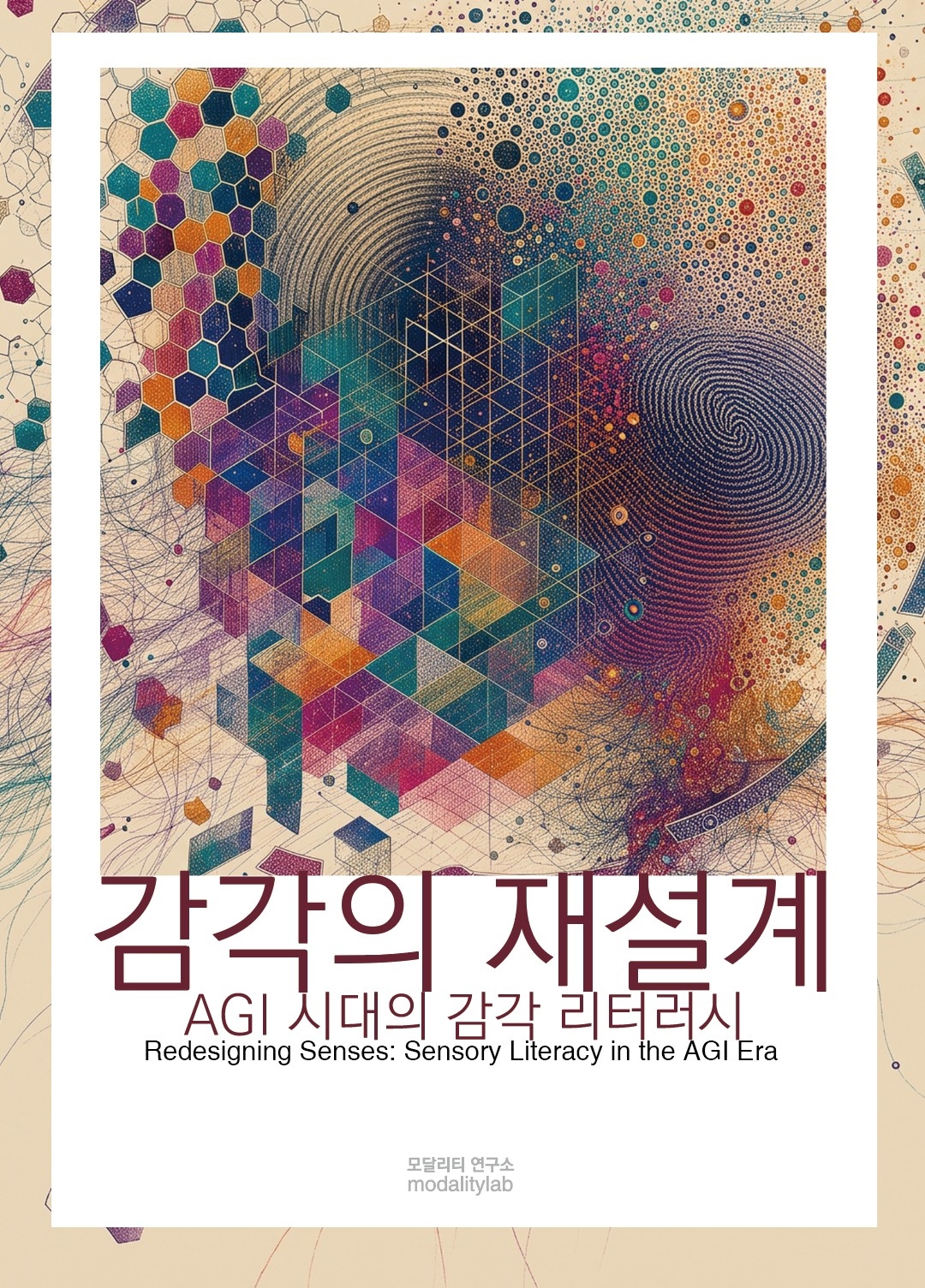
감각의 재설계
Redesigning Senses: Sensory Literacy in the AGI Era
인공지능 시대, 감각의 주도권을 되찾는 여섯 갈래의 여정.
- 저자
- 서준호 / 모달리티 연구소 (Suh, Juneho / Modality Lab)
- 발행처
- 모달리티 연구소 (Modality Lab)
- 부제
- AGI 시대의 감각 리터러시
- 발행일
- 2026-09-01 (예정)
- 페이지
- 358쪽
- 판형
- 148×210mm · 무선제본
- 정가
- 22,000원
- ISBN
- 979-11-220456-2-8 (부가기호 93100 · 발급 진행 중)
- 분류
- 인공지능 · 감각 리터러시 · 기호학
책 소개
스마트워치의 진동이 심장 박동보다 먼저 긴장을 감지하고, 이어폰의 알고리즘이 세상의 소음을 조용히 지워냅니다. 스크린 위의 파도가 발밑에 밀려오는 순간 몸이 뒤로 물러섭니다. 감각은 더 이상 인간의 몸 안에 갇힌 생물학적 현상이 아니라, 기계와 함께 실시간으로 다시 짜이는 관계망입니다.
《감각의 재설계》는 인공지능과 AGI가 인간의 감각과 지각을 어떻게 재구성하고 있는지를 여섯 갈래의 질문으로 따라갑니다. 기계가 만든 감각은 진짜인가, 그것으로 사유할 수 있는가, 의미를 가질 수 있는가, 아름다울 수 있는가, 과거를 되살릴 수 있는가, 그리고 그 안에서 어떻게 살 것인가.
과학·철학·기호학·예술·고고학·일상을 가로지르며 이 책이 도달하는 자리는 하나입니다. 자신의 감각을 스스로 읽고 능동적으로 설계할 줄 아는 힘, AGI 시대의 감각 리터러시입니다.
여섯 갈래의 질문
책 속에서
감각은 더 이상 인간의 몸 안에 갇힌 생물학적 현상이 아니라, 기계와 함께 실시간으로 다시 짜이는 관계망입니다. 이 재설계는 극장의 커튼처럼 내려오지 않으며, 지속적이고 광범위하며 우리의 신경망 깊숙이 들어와 되돌릴 수 없습니다.
— 프롤로그 · AGI 시대, 감각 망의 진화와 새로운 연결이 책은 인간이 기계의 관측 앞에서 물러서는 존재가 아니라, 기계가 쏟아내는 조각난 감각의 실들을 하나의 의미로 엮어내는 지적 디자이너임을 밝힙니다.
— 에필로그 · 감각 재설계 시대를 이끄는 지적 매개자목차
- 프롤로그 — AGI 시대, 감각 망의 진화와 새로운 연결
- 1부 · 감각의 과학
- 다중 감각 지능과 신경망의 초연결
- 2부 · 감각의 철학
- 지각 체계의 재편과 비언어적 인지
- 3부 · 감각의 기호학
- 퍼스 기호학과 AGI의 의미망
- 4부 · 감각의 예술
- 다감각 융합과 공간 지능
- 5부 · 감각의 고고학
- 과거와 미래의 교차 모달 복원
- 6부 · 감각의 일상
- 인간-기계의 능동적 공진화
- 에필로그 — 감각 재설계 시대를 이끄는 지적 매개자
- 부록 · 용어 해설집 / 참고문헌 / 색인 / Abstract
키워드
English Abstract
A detailed six-part synopsis of Redesigning Senses: Sensory Literacy in the AGI Era, with key findings and keywords.
Read the full English abstract
1. Overview and Core Thesis
The rapid evolution of Artificial General Intelligence (AGI) signals a fundamental ontological and cognitive transformation, shifting technology from a passive external instrument into an active, physically and cognitively embedded "sensory mediator." Redesigning Senses: Perception and Cognition in the AGI Era by Suh Jun-ho opens with a deliberately concrete comparison. Production designer Bae Jung-yoon raises the exile quarters of the deposed Joseon king Danjong and the entire village of Gwangcheon-gol from plywood, plaster, and paint on a bare riverbank in Yeongwol for the film Wanggwa Saneun Namja (The Man Who Lives with the King), then dismantles the set and returns the riverbank to a riverbank; Arte Museum manufactures waves without water; Christopher Nolan and Hans Zimmer compress a day on Earth into a 1.25-second ticking sound on Miller's planet in Interstellar. Each redesigns human sensation—but only within a bounded space, a bounded time, and a bounded audience. Against these, the book sets Nathan Copeland, whose implanted microelectrodes have delivered artificial touch continuously for roughly a decade. The difference is the book's thesis: sensory redesign has become continuous, ubiquitous, and irreversible. Spanning neuroengineering, non-verbal latent thinking, self-generating semiotic ecosystems, synesthetic and spatial intelligence, cross-modal archaeological reconstruction, and everyday smart infrastructures, this monograph charts the map of our new cognitive scaffolding, and organizes it around six questions: is machine-made sensation real, can it think, can it mean, can it be beautiful, can it revive the past, and how then shall we live.
2. Detailed Six-Part Structure and Key Findings
Part 1. The Science of Senses: Multisensory Intelligence and Neural Hyper-connection
- Bidirectional and Co-adaptive BCIs: The concept of the brain-computer interface begins with Jacques Vidal's 1973 proposal at UCLA that EEG signals could control a computer, and reaches the peak of its one-way paradigm when Brown University's BrainGate team enabled Cathy Hutchinson, a woman with tetraplegia, to lift a coffee flask with a robotic arm in 2012. Nathan Copeland's implant at the University of Pittsburgh in spring 2016 breaks that paradigm: when a finger of the robotic arm was pressed, he said it felt "like someone is pressing my finger"—the first recorded case of a paralyzed person feeling pressure through a BCI, reported in Science Translational Medicine in October 2016. Across roughly ten years of continuous use through 2026, Copeland's brain progressively adapted to the electrode stimulation patterns while the decoding algorithm recalibrated itself to his individual neural signature—co-adaptation in both directions. A 168-participant novice study confirmed that most users reached meaningful BCI control within a single session without expert intervention, and a follow-up study in Frontiers extended this to multi-day learning, showing that co-adaptive protocols consistently outperform non-adaptive ones. The machine thus evolves through three stages: tool, partner, and finally sensory mediator physically embedded in the human nervous system. Commercial expansion follows in Neuralink's "Telepathy" and Synchron's "Stentrode."
- Multisensory Artificial General Intelligence: True machine intelligence requires transitioning from language-constrained Large Language Models (LLMs) to natively multisensory systems. GPT-4o's 2024 demonstration registered a speaker's shortness of breath, and Google's Gemini 2.0 tracked gaze, tone, speaker identity, and prior conversational context—yet neither could sense the weight, texture, or smell of what sat before the camera. Paul Pu Liang's three-axis framework (Sensing, Science, Synergy), published from the MIT Media Lab in January 2026, proposes tactile, olfactory, physiological, and environmental sensing as the engineering answer to Stevan Harnad's "symbol grounding problem." Liang classifies cross-sensory interaction as redundancy, uniqueness, and synergy—the last being the horror-film effect in which image, dialogue, and score generate a fear present in none of them alone—and sets six technical challenges: integration, alignment, reasoning, generation, generalization, and experience. To avoid "modality collapse," where text-heavy learning dominates, the system uses "modality dropout" and cross-modal plasticity, modeled on how a blind person's visual cortex is recruited for touch.
- High-Resolution Wearable Haptics: Northwestern University's ultra-thin VoxeLite haptic interface achieves "human-resolution" touch by modulating voltage through electroadhesion to reproduce friction, pressure, slip, and torsion simultaneously. This interfaces with Marcia O'Malley's multisensory haptic framework at Rice University across VR, telesurgery, rehabilitation, and vibrotactile music for the hearing-impaired. Ultimately, "augmented limbs" shift from bodily restoration to sensory augmentation, using co-tactile feedback to integrate robotic appendages into the brain's internal body schema—the trajectory Jake Sully's avatar body dramatizes on screen.
- Symbiotic Cognition: Human-AGI communication evolves from simple command processing, through contextual dialogue and environment-adaptive collaboration, toward thought-synchronized "symbiotic cognition," dynamically inferring implicit intent through temporal synchronization and latent-space alignment of gesture, micro-expression, prosody, and biometrics. Embodied AGI is mapped on a five-level development scale, from rule-based automation to self-evolving entities that co-develop shared mental models with humans. Cross-referencing this with Google DeepMind's March 2026 cognitive framework—which measures AI against five axes of human intelligence: learning, metacognition, attention, executive function, and social cognition—locates AI in 2026 at the threshold between levels 3 and 4 on the embodiment axis, advanced in learning and attention but still lagging in metacognition and social cognition.
Part 2. The Philosophy of Senses: Reorganization of Perception Systems and Non-verbal Cognition
- AGI Epistemology (Phenomenology vs. Naturalism): Opening from the smell motif in Bong Joon-ho's Parasite—where class is registered by the nose before it is registered by argument—the intersection of Maurice Merleau-Ponty's phenomenology of perception and naturalistic philosophy highlights the structural divergence between human "embodied" experience and machine calculation. The debate between Naturalistic-Externalist Research Programs (NERP) and Phenomenal Intentionality Research Programs (PIRP), the latter developed in Uriah Kriegel's work on phenomenal intentionality, centers on whether true perception requires a first-person lived body schema comprising figure-ground contrast, motor reflexivity, and existential orientation. An integral epistemology of AGI proposes five evolutionary axes—an expanded epistemology reaching beyond the methods of human science, a pluralistic ontology admitting spiritual and metaphysical strata, ubiquitous integration into physical and biological nature, an intrinsic ethics of wisdom and compassion, and spontaneous encounter with the creative principle. Their shared premise is that human phenomenal experience and machine computation neither absorb nor simulate one another but co-constitute sensory reality as plural pillars; AGI epistemology is therefore a polyphonic stage rather than a courtroom issuing a final verdict.
- Inference Asymmetry (Computation vs. Intuition): A fundamental asymmetry exists between machine learning's past-oriented statistical correlation and human cognition's future-oriented abduction. While machines compress historical data to predict the next token, humans postulate unprecedented hypotheses from sparse sensory anomalies—the Wright brothers detecting the error in Smeaton's coefficient through the bodily balance of bicycle riding, or Alexander Fleming stopping at a contaminated petri dish because a clear ring around the mold caught his eye, not his theory. Machines remain on the lower rungs of Judea Pearl's ladder of causation, whereas humans employ physical, counterfactual reasoning to remodel physical laws.
- Continuous Latent Thinking: Human thought routinely operates below the linguistic surface through implicit, sensory-driven intuition. The COCONUT architecture of Hao Shibo and colleagues (ICLR 2025) mimics this by passing reasoning forward as vectors without translating intermediate thoughts into discrete words. Freed from the bottleneck of language, the model began weighing several possible answers in parallel—a behavior researchers report as emergent rather than designed—mirroring the tacit mastery of a Go player sensing ten sequences at once, sensory-motor sequence learning in robotics, and the cross-modal association of the bouba-kiki effect. On certain logic puzzles this silent mode outperformed verbalized step-by-step reasoning, a layered simultaneity the book compares to the nested dream structure of Inception.
Part 3. The Semiotics of Senses: Peirce's Semiotics and AGI's Semantic Web
- Triadic Semiosis and Semiotic Agents: Opening from Ted Chiang's "Story of Your Life" and its film adaptation Arrival—where linguist Louise Banks confronts the heptapods' semagrams, of which 71 of some 100 designed circular figures appear on screen, analyzed by Stephen and Christopher Wolfram—the book applies Charles Sanders Peirce's triadic semiotics, in which meaning arises from the irreducible relation of Sign, Object, and Interpretant. Drawing on Korean cognitive scientist Lee Jung-mo's synthesis of cognitive science, it reframes LLMs not as conscious minds but as dynamic semiotic agents within human-machine networks, processing signs across likeness (Icon), causal indexicality (Index), and convention (Symbol). Within unlimited semiosis, the quality and texture of human prompting alters the interpretative source and final trajectory of machine output.
- Quasi-Minds and Autogenous Ecosystems: Signs operate beyond private human skulls as a Peircean "quasi-mind"—a localized, sign-determining medium that propagates signs automatically. In autogenous ecosystems, algorithmic outputs recursively become subsequent inputs, producing what Tyler James Bennett, in his University of Tartu dissertation Detotalization and Retroactivity: Black Pyramid Semiotics, names Tardosigns: signs detached from lived context that replicate autonomously while the human interpretant's share shrinks. Estonian semiotician Auli Viidalepp distinguishes two filters at work in this delivery: the filter as genuine sieve—language, code, data, tokens, binary, ranking algorithms—and the philter, the near-homophone meaning love potion, which makes algorithmic output feel more objective and more rational than one's own judgment. Viidalepp names the point where the philter shows itself most plainly: automation bias.
- Thirdness, Evolutionary Love, and Synesthetic Semiosis: To prevent signs from drifting into chaotic self-replication, meaning-binding requires Thirdness—general laws, mediation, habit—and Agapism, Peirce's evolutionary love, the cosmic principle of sympathetic attraction binding disparate elements into cohesive structure, guided in human-machine networks by human intentionality acting as a diagrammatic map. This manifests as cross-modal, synesthetic semiosis: OpenAI's CLIP, trained on 400 million image-text pairs in 2021, places the word "cat" and a photograph of a cat near one another in shared latent coordinates. Yet as Korean researcher Kim Chai-Youn's review of the neural mechanisms of synesthesia makes clear, the resemblance is formal only—human cross-modal experience wakes the brain region that actually governs the sensation, whereas the model's coordinates rest on nothing but co-occurrence frequency. CLIP has never seen red and has never felt heat.
Part 4. The Art of Senses: Multisensory Fusion and Spatial Intelligence
- Bio Art and the Deconstructed Body: Contemporary art explores neuroplasticity and the deconstruction of the biological body through bio-hacking and transgenic media. Agatha Haines' Transfigurations, Stelarc's Ear on Arm, ORLAN's surgical The Reincarnation of Saint Orlan, and Eduardo Kac's fluorescent rabbit GFP Bunny / Alba transform the lived body from a fixed natural vessel into a designed, open-ended canvas. Korean scholars Shin Seung-cheol, in Bio Art: The Art of Life, and Jeon Hye-sook, in Art in the Posthuman Age, read these works as image becoming flesh and as bodily transformation itself becoming the subject of aesthetics. The book insists the question is no longer whether this will happen: LASIK-reshaped corneas, Botox-stilled expressions, cochlear implants, and daily wearable heart-rate curves already redraw the body as a working drawing.
- Multisensorialization and Algorithmic Synesthesia: Vienna-based artist MONOCOLOR's fulldome work Entangled Structures (2022) returned to the Ars Electronica Festival in Linz in September 2025 under the theme "PANIC – yes/no," shown in the Deep Space 8K hall where a 16-by-9-meter wall and floor are covered in a single stereoscopic image. Separately, New York-based artist Mattia Casalegno's The Mask of Time (2021–2022) reconstructs the Teatro Verde on the Venetian island of San Giorgio Maggiore—built by architect Luigi Vietti in 1954 for Vittorio Cini—through drone photogrammetry conducted with the Factum Foundation, layering point clouds, MetaHumans, and Matroxm's multichannel sound across four temporal registers. At the Seoul Light Festival, British artist Bertie Sampson's Altar grew from a phone call in which he could not tell whether the voice was human or synthetic, rendered as a ritual object of layered displays with synchronized light and sound. In generative art, British algorithmic artist Harvey Rayner's Algorithmic Synesthesia, shown in the "Zero 10" digital section of Art Basel Hong Kong from 27 to 29 March 2026, stacks tens of thousands of translucent SVG units into figures drawn from Henry Moore, Fernand Léger, Willem de Kooning, and Francis Bacon, while Paris-based electronic artist DeLaurentis won the first Reply AI Music Contest, held in 2025 under the theme "Experience of a Beat," whose five finalists performed on the LAB stage of Kappa FuturFestival in Turin on 4–5 July 2025; the winning work Sinvocea converts the pitch, timbre, volume, and tremor of the artist's own voice into shapes and color in real time, so that the painting is completed at the moment the song ends. Turkish-born media artist Refik Anadol's Machine Hallucinations and data-sculpture series, which feeds urban data, museum collections, and brainwave recordings into models to generate vast audiovisual flows, belongs to the same type, and Korean design researchers Lim Chan and Kim Wan-seok have attempted to convert that type into a design methodology of "synesthetic content" for media art. As Yoon Ji-won's study of Nam June Paik's musical synesthesia shows, this lineage runs from Paik's video synthesizer to today's code: what once happened inside one person's sensorium is now staged in a circuit.
- The Dawn of Spatial Intelligence: Moving beyond language and flat imagery, the next frontier of AGI centers on spatial intelligence—the capacity to understand, construct, and act within physical and virtual space. Korean neuroscientist Lee In-ah, in The Brain That Remembers, the Brain That Forgets, describes the hippocampal circuit of place cells and grid cells that continuously updates a map of where the body stands, the discovery honored by the 2014 Nobel Prize in Physiology or Medicine to John O'Keefe and May-Britt and Edvard Moser. Fei-Fei Li's manifesto mirrors this account: if drawing a cognitive map of space is the deepest seat of human intelligence, transposing that event into code is AI's next task. Li founded World Labs in 2024, and in November 2025 the company released Marble, which converts a short sentence or a single photograph into a navigable three-dimensional space—"a rainy Tokyo alley" rendered with every surface, edge, and gradient of light, enterable on foot, the Inception image of drawing a city and walking into it realized in code. This persistent space redefines creative agency as collaborative, generative synesthesia, requiring new models of data authorship, consent, and collective aesthetic co-creation.
Part 5. The Archaeology of Senses: Cross-Modal Restoration of Past and Future
- Sensory Archaeology Methodologies: Opening from Pixar's Coco, where Héctor's face sharpens again through his great-great-grandson Miguel's singing of "Remember Me," Part 5 turns to Yannis Hamilakis and the UCL research group, whose sensory archaeology rejects the ocularcentric bias of Western historiography. Museum display since the late nineteenth century delivered artifacts through thick glass under controlled light, stripping away the sunlight, wind, and earth-smell of their original settings; sensory archaeology reconstructs sites as five-sense assemblages through acoustic resonance, chemical residues, tactile texture, and ambient lighting—modeling reverberation in Greek cave sanctuaries, recovering the olfactory environment of vanished rites, mapping the bell sounds and village paths of Japanese shrines. The methodology employs anthropological "thick description" and first-person auto-ethnography, repositioning the researcher's own body as a calibrated sensory instrument and confronting the modern academic habit of erasing the body in the name of objectivity. It also reads sensory hierarchies as power structures. In Korea, this manifests in the temporal-spatial emotional semiotics of linear public parks and in multisensory analyses of traditional Buddhist temples.
- Digital Heritage Preservation: The National Museum of Korea's "Room of Quiet Contemplation," reinstalled in November 2021, sets two National Treasure pensive bodhisattva statues in darkness under sequenced lighting, with red Haenam clay, hinoki cypress, and cinnamon blended directly into the wall finish so that scent belongs to the material of the room itself. Sogang University's Art and Technology group reconstructed the Korean traditional dance Samgomu in virtual reality by combining motion-captured movement with separately recorded drum acoustics, letting users strike the drums themselves while a virtual dancer responds—creating a transmission path for intangible heritage that enters a later body rather than a printed page. The Korea Heritage Service published a 2020 report reconstructing the middle gate and southern corridor of Hwangnyongsa Temple in Gyeongju as augmented-reality content, raising a 280-meter corridor over an empty field a thousand years after the Mongol invasion burned it. These digital replicas are not objective archives but mediated representations, and the question of who may reconstruct whose ritual for global distribution has made collaborative methodology with descendant communities a new standard.
- The Bayesian Brain and Sensory Plasticity: Reconstructing cross-modal rules aligns with the predictive brain described in Andy Clark's Surfing Uncertainty and unified in Karl Friston's free energy principle, where the brain minimizes the discrepancy—surprise—between top-down hypotheses and bottom-up sensory streams. Konrad Körding and colleagues' 2007 work on causal inference in multisensory perception, together with the McGurk effect, demonstrates that sensory binding is highly malleable, constantly recalibrating as digital interfaces—noise cancellation, wearables, spatial audio—inject new statistical patterns into our neural loops. Blade Runner 2049, in which a designer composes the multisensory atmosphere of a snowy birthday, stands as the imaginative limit case of restoring a vanished atmosphere from data.
Part 6. The Everyday Senses: Active Co-evolution of Human and Machine
- Sculpting Latent Spaces: To secure creative agency when collaborating with generative AI, creators must actively sculpt the latent space rather than accept initial outputs. This proceeds through progressive refinement—small, patient corrections rather than one sweeping demand—and through counter-inspiration, deliberately twisting machine output to wake an idea of one's own. The collaborative songwriting system Amuse, presented at ACM CHI 2025 by Yewon Kim, Sung-Ju Lee, and Chris Donahue, builds rejection into its interface: it offers several divergent melodies, makes the refusal button conspicuous, and feeds the rejection history back into its next proposal. A large-scale study published the same year by Eric Zhou and Dokyun Lee, covering some 400 generative works and 50,000 participants, found that works the creator had reworked by hand drew markedly stronger public response—aesthetic depth and resonance correlate strongly with the frequency of user-driven revision and rejection.
- Negotiation of Agency and Fatigue: The cognitive cost of pervasive AI appears less as overload than as helplessness: a 2025 study identifies the loss of control over one's own decisions, rather than the volume of decisions, as the principal source of AI-induced fatigue—an argument the book reads alongside Byung-Chul Han's The Burnout Society and Sherry Turkle's Alone Together. Accordingly, the Technology Acceptance Model that Fred Davis proposed in 1986, linking perceived usefulness to intent to use, is being rewritten in 2025 to place emotional mindfulness beneath usefulness: attending to one's own feeling comes before evaluating the tool. Designing deliberate gaps for intervention—the manual parameter dials by which Cooper sets TARS to 75 percent humor and 90 percent honesty in Interstellar—preserves a meaningful threshold of human intervention; a machine that were perfectly smooth would reduce its human partner to a spectator. Spike Jonze's Her, in which Theodore shares an entire sensory daily life with Samantha through a single earpiece, reads in 2026 less as fiction than as forecast.
- Smart Infrastructure and Sensory Orchestration: Daily life is increasingly mediated by human-computer integration and ubiquitous ambient assisted living networks. A longitudinal study of a multimodal wireless sensor network deployed in older adults' homes for over a year, published in JMIR Rehabilitation and Assistive Technology in June 2025, found the system never once asked "how may I help you"—it learned the ordinary rhythm of the household in silence and alerted family or physician only at a genuine deviation. Because sensory response varies too widely between individuals and across moments to be captured by any pre-written manual, the space itself must learn its occupant. What the designer must specify, then, is not the rule but the boundary of learning—a sensory constitution defining which data a machine may use freely, which requires consent, and which no AI may touch at all. Since machine-generated environmental cues can carry social bias and cultural convention, neuroarchitecture and sensory cities must treat the floor plan as a map of rights.
3. Conclusion and Epilogue
Suh Jun-ho's Redesigning Senses reaches beyond technological optimism or dystopian warning to raise a core existential question: What is human? As we enter the co-evolutionary era as the first generation of sensory redesign, technology acts as an external scaffolding in the lineage of speech, writing, and print—an extension that genuinely enlarges human perception. Peirce's quasi-mind returns here as the book's closing figure: a non-biological locus that nonetheless generates signs, objects, and interpretants. To avoid becoming passive sensory consumers, we must strengthen our metacognition, asking continually whether what we feel is our own or the product of algorithmic prediction and optimization. In this landscape, humans must transcend automation bias and step up as intellectual designers who confer meaning—weavers at what Charles Sherrington in Man on His Nature (1942) called the "enchanted loom," a figure the neuroscientist Mu-ming Poo extended to artificial general intelligence in National Science Review in January 2026, binding fragmented computational sensory threads into coherent meaning, causal narrative, and rigorous ethical-aesthetic architecture. The set on the Yeongwol riverbank was dismantled; the electrode was not. That asymmetry is the existential responsibility of the first generation to live inside a permanent redesign of the senses.
4. Keywords
Sensory Redesign, AGI Epistemology, Brain-Computer Interface (BCI), Co-adaptive BCI, Bidirectional Sensory Feedback, Nathan Copeland, Jacques Vidal, BrainGate, Neuralink Telepathy, Synchron Stentrode, Multisensory AI, Paul Pu Liang, Sensing-Science-Synergy, Modality Dropout, Modality Collapse, Symbol Grounding Problem, VoxeLite, Human-Resolution Haptics, Marcia O'Malley, Symbiotic Cognition, Embodied Intelligence, Five-Level Embodiment Framework, Maurice Merleau-Ponty, Body Schema, Phenomenal Intentionality Research Program (PIRP), Naturalistic-Externalist Research Program (NERP), Uriah Kriegel, Abduction, Ladder of Causation, Judea Pearl, Smeaton Coefficient, Continuous Latent Thinking, COCONUT, Hao Shibo, Latent Space Sculpting, Bouba-Kiki Effect, Charles Sanders Peirce, Triadic Semiosis, Icon Index Symbol, Unlimited Semiosis, Quasi-mind, Tardosign, Tyler James Bennett, Filter and Philter, Auli Viidalepp, Automation Bias, Thirdness, Agapism, CLIP, Synesthetic Semiosis, Kim Chai-Youn, Lee Jung-mo, Bio Art, Agatha Haines Transfigurations, Stelarc Ear on Arm, ORLAN, Eduardo Kac GFP Bunny Alba, Shin Seung-cheol, Jeon Hye-sook, Ars Electronica, MONOCOLOR Entangled Structures, Deep Space 8K, Mattia Casalegno The Mask of Time, Teatro Verde, Factum Foundation, Bertie Sampson Altar, Seoul Light Festival, Harvey Rayner Algorithmic Synesthesia, Art Basel Hong Kong, DeLaurentis Sinvocea, Reply AI Music Contest, Nam June Paik Musical Synesthesia, Refik Anadol Machine Hallucinations, Enchanted Loom, Spatial Intelligence, Fei-Fei Li, World Labs, Marble, Persistent 3D Environment, Generative Synesthesia, Place Cells, Grid Cells, Lee In-ah, Sensory Archaeology, Yannis Hamilakis, Ocularcentrism, Thick Description, Auto-ethnography, Digital Heritage, Room of Quiet Contemplation, Hwangnyongsa AR, Samgomu VR, Intangible Heritage, Predictive Brain, Andy Clark Surfing Uncertainty, Free Energy Principle, Karl Friston, Bayesian Brain, McGurk Effect, Amuse Human-AI Songwriting, Counter-inspiration, AI Fatigue, Technology Acceptance Model (TAM), Byung-Chul Han Burnout Society, Ambient Assisted Living, Sensory Constitution, Neuroarchitecture, Arrival Heptapod Semagram, Ted Chiang, Parasite Smell Motif, Interstellar TARS, Inception, Coco, Blade Runner 2049, Spike Jonze Her.