Summary
Since 2023, the convergence of artificial intelligence and robotics has moved beyond a generational turnover within the technology ecosystem and now signals a more fundamental event: machine agents have begun to enter the horizon of multisensory meaning-making alongside human beings. This working paper, the inaugural issue of the Modality Lab Working Paper Series, argues that this juncture, which it names the “Physical-AI era” (from July 2023, marked by the appearance of RT-2), cannot be adequately grasped as a mere technological trend. It must instead be re-read as a phenomenon of co-presence: a situation in which human and machine become two mutually dependent embodied subjects that jointly constitute a shared field of Modality.
The paper advances a single overarching claim: human-machine co-embodiment does not extend the human sensorium (as in the McLuhan tradition) but brings a new Modality into presence through the horizontal coexistence of distinct embodied subjects. To substantiate this, it integrates phenomenology (Merleau-Ponty, Ihde), Peircean semiotics, philosophy of technology (Simondon), posthumanist theory (Hayles, Barad), and science-and-technology studies (Suchman) into a four-tier communicative framework, Mode · Modal · Modality · Medium (the “M4 framework”), and introduces co-modal coupling as the abductive logic that drives the joint sign-action between human and machine. From four diagnostic propositions the paper derives four design principles and a procedural checklist for designers, and closes by projecting the theoretical, practical, and regulatory implications for the Physical-AI era.
The argument proceeds strictly one-directionally (diagnosis → design → implication) and rests only on verified primary-source industry data (2025-2026) and canonical theoretical texts, treating industrial cases (Waymo, Agility Digit, Hyundai-Boston Dynamics Atlas, NVIDIA Cosmos, and others) as illustrative evidence subordinate to the theory.
1. Point of Departure and Method (§1 Framing)
- The founding observation: The 2023-onward coupling of AI and robotics indicates that machine agents have begun to participate, beside humans, in a horizon of multisensory meaning generation. RT-2 (Google DeepMind, July 2023) is taken as one inflection point (§1.1).
- Conceptual extension: The paper extends the concept of embodiment from human embodiment (the phenomenological tradition) to machine embodiment, deliberately distinguished from mere “implementation” so as to foreground corporeality and sensoriness (§1.2).
- Standpoint: The juncture is re-interpreted not as a technology trend but as a phenomenon of co-presence: a shift from tracking events to diagnosing a situation (§1.3).
- Three methodological principles govern the whole paper: (1) theory takes priority, with the six-axis industrial terrain used only as illustrative material; (2) interdisciplinary integration of theoretical resources (phenomenology, semiotics, media theory, STS); (3) conceptual precision: key terms are held stable across contexts rather than allowed to drift.
2. Part I: Present Coordinates (Current State)
The six-axis terrain of machine embodiment (§2). Machine embodiment is mapped across six axes, presented as evidentiary material rather than as the object of the argument:
- Consumer/home appliance axis (§2.1)
- Industrial axis (§2.2): the largest resource commitment and clearest commercial demand
- Autonomous-driving axis (§2.3)
- Medical/healthcare axis (§2.4): the most direct coupling with the human body
- World-model axis (§2.5)
- Humanoid axis (§2.6)
The present coordinates of Modality (§3). The paper then locates the Modality that machine embodiment produces here and now:
- Integrated multisensory-channel architecture (§3.1)
- Entry of touch, proprioception, and olfaction into machine sensing (§3.2)
- Reorganization of human-machine interaction Modality (§3.3)
- Reconstruction of spatial/environmental Modality (§3.4)
- The machine Umwelt and the pressure it places on the Modality hierarchy (§3.5)
Part I closes by carrying the analysis from phenomenon to situation: the pivot into the diagnostic core (§4).
3. Part II: Diagnosis (The Four Diagnostic Propositions)
Part II re-defines the situation: from a single-subject Modality to a joint (co-) Modality.
- Diagnostic Proposition 1: Mutually dependent co-Modality of two embodied subjects. Human and machine constitute Modality jointly and interdependently, not as one subject wielding a tool. Grounded in an extension of Merleau-Ponty's flesh (la chair) from the human body to the human-machine coupling (§5.2), a juxtaposition of Ihde's post-phenomenological embodiment relations with Simondon's theory of technical objects (§5.3), and a re-application of Uexkull's Umwelt to the machine (§5.4).
- Diagnostic Proposition 2: Reorganization of the Mode layer and the establishment of the four-tier frame. The lowest tier (Mode: the sensory channel, the “what”) is reorganized once machines sense, grounded in Peircean semiosis (§6.2), yielding the formal Mode · Modal · Modality · Medium hierarchy (§6.3).
- Diagnostic Proposition 3: Horizontal coexistence, not extension. Against McLuhan's extension-of-man model (§7.1), the paper argues for the horizontal coexistence of distinct embodied subjects, drawing on Hayles's posthumanism (the inseparability of information, matter, and body, §7.2) and Barad's intra-action / agential realism (the dissolution of the subject-object dichotomy, §7.3), extending to fleet- and swarm-level coexistence of multiple machine subjects (§7.4).
- Diagnostic Proposition 4: Human-machine co-embodiment brings a new Modality into presence. Read through Peirce's triadic categories (Firstness/Secondness/Thirdness mapped onto exteroception / interoception / meta-mediation, §8.2), with abduction (가추법) identified as the logical driver of co-modal coupling (§8.3), which is then formally introduced as a field of triadic sign-action standing on the Simondonian lineage of couplage (§8.4).
4. Part III: Design (The Four Design Principles)
From the four diagnostic propositions the paper derives four design principles for human-machine systems:
- Design Principle 1: A reciprocal structure, not a hierarchy. Reject the command-and-execution model, following the implications of Suchman's Human-Machine Reconfigurations (§9).
- Design Principle 2: Avoid pre-specifying the mode of coupling. The coupling should be allowed to form dynamically; read through the Clark-Chalmers extended-mind hypothesis, with Medium understood as the environment in which coupling dynamically takes shape (§10).
- Design Principle 3: Explicitly acknowledge asymmetry. The human's living body and the machine's fabricated body are not equivalent; concealing this (e.g., through humanoid anthropomorphism) is a design risk, and the asymmetry should instead be converted into a design resource (§11).
- Design Principle 4: Adopt PBM (Performative Body-Mapping) as a design prototype. Beginning from dancer-robot collaboration (Gemeinboeck & Saunders), the exploration of morphological affordances dismantles the subject-object dichotomy and extends to general HRI design; PBM is shown to correspond structurally to co-modal coupling, so that design answers diagnosis (§12).
Part III concludes with a procedural checklist for designers organized into four inspection bundles, one per design principle, covering hierarchy, coupling mode, asymmetry, and the co-production of the interpretant (§13).
5. Part IV: Implications and Series Position
Three-tier implications (§14)
- Theoretical: Re-definition of the Physical-AI juncture as a co-modal coupling situation.
- Practical: Mutual-alignment design principles for industrial deployment.
- Regulatory: A re-setting of the object of regulation toward the human-machine coupling, read against the EU AI Act and the Republic of Korea's Framework Act on AI (AI Basic Act, in force 22 January 2026).
Series position and roadmap (§15 and §16)
- This issue leaves the series its skeletal framework and identifies the next issue, WP 2026-02, on the computational rendering of the Modal layer in latent space (§15.2).
- The series roadmap sequences future diagnoses along the Modal, Mode, and Medium axes (§15.3).
- Conclusion: What this issue demonstrates is the diagnostic precision of the Modality axis; what it leaves behind is the identity and keynote of the series as a whole (§16).
Key Concepts (Glossary)
- Machine Embodiment (기계 체현): Embodiment predicated of the machine, foregrounding corporeality and sensoriness; deliberately distinguished from “implementation.”
- Co-Modality / Joint Modality (공동 Modality): Modality constituted jointly and interdependently by two embodied subjects (human and machine), rather than by a single subject.
- Co-modal coupling: (term kept in the original) The abductively driven, triadic field of sign-action between human and machine; the paper's central diagnostic construct, positioned on the Simondonian lineage of couplage.
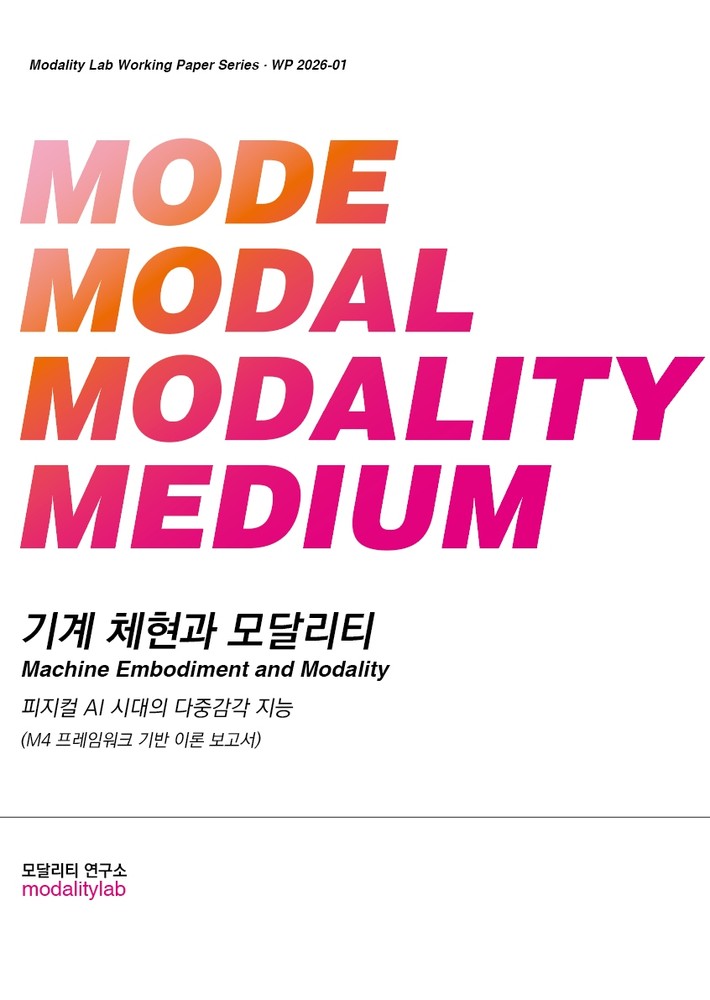
- The M4 Framework (Mode · Modal · Modality · Medium): A four-tier communicative hierarchy: Mode (the sensory channel, the “what”), Modal (the manner/state, the “how”), Modality (the topmost, total structure of experience), and Medium (the carrier/environment of coupling).
- Abduction (가추법): Peirce's third mode of inference, identified as the logical engine of co-modal coupling.
- Machine Umwelt (기계 움벨트): Uexkull's Umwelt re-applied to the machine as its own world of relevance and sensing.
- PBM (Performative Body-Mapping): A performative, dancer-robot-derived design approach (Gemeinboeck & Saunders) adopted as the design prototype for co-modal coupling.
- Physical-AI era / “post-2023”: The paper's temporal coordinate for the diagnosed situation (never framed as an “AGI era”).
Keywords
machine embodiment · co-modal coupling · Modality · Mode-Modal-Modality-Medium (M4) · Peircean semiotics · abduction · phenomenology of the flesh (Merleau-Ponty) · post-phenomenology (Ihde) · Simondon · Uexkull's Umwelt · agential realism (Barad) · posthumanism (Hayles) · human-machine reconfiguration (Suchman) · extended mind (Clark & Chalmers) · Performative Body-Mapping (PBM) · Physical AI · human-robot interaction (HRI)
Keywords
Contents
- §1Introduction: proposing the concept of machine embodiment and the standpoint of this report
- §2The broad terrain of machine embodiment: a six-axis structure
- §3The present coordinates of the Modality that machine embodiment produces
- §4Summary of Part I: from phenomenon to situation
- §5Redefining the situation: from single-subject Modality to co-Modality
- §6Reorganization of the Mode layer and establishment of the four-tier frame
- §7Horizontal coexistence of embodied subjects: coexistence, not extension
- §8The abductive dimension of co-embodiment
- §9The starting point of design: principles derived from the four diagnostic propositions
- §10Dynamic coupling of multiple Modes
- §11Explicit acknowledgment of asymmetry
- §12Adopting PBM (Performative Body-Mapping) as a design prototype
- §13Synthesis of Part III: a procedural checklist for designers
- §14Three tiers of implication: theoretical, practical and regulatory
- §15Series position and preview of the next issue
- §16Conclusion
How to Cite
Suh, J. (2026). 기계 체현과 모달리티: 피지컬 AI 시대의 다중감각 지능 [Machine embodiment and modality: Multisensory intelligence in the physical-AI era] (Modality Lab Working Paper Series No. 2026-01). Modality Lab. https://doi.org/10.68053/wp.2026.01
Suh, Juneho. "기계 체현과 모달리티: 피지컬 AI 시대의 다중감각 지능 [Machine Embodiment and Modality: Multisensory Intelligence in the Physical-AI Era]." Modality Lab Working Paper Series, no. 2026-01, Modality Lab, 2026, https://doi.org/10.68053/wp.2026.01.
Suh, Juneho. "기계 체현과 모달리티: 피지컬 AI 시대의 다중감각 지능 [Machine Embodiment and Modality: Multisensory Intelligence in the Physical-AI Era]." Modality Lab Working Paper Series, WP 2026-01. Modality Lab, 2026. https://doi.org/10.68053/wp.2026.01.
@techreport{suh2026machine,
  author       = {Suh, Juneho},
  title        = {기계 체현과 모달리티: 피지컬 AI 시대의 다중감각 지능
                  [Machine Embodiment and Modality: Multisensory Intelligence
                  in the Physical-AI Era]},
  institution  = {Modality Lab},
  series       = {Modality Lab Working Paper Series},
  number       = {WP 2026-01},
  year         = {2026},
  month        = {8},
  doi          = {10.68053/wp.2026.01},
  url          = {https://doi.org/10.68053/wp.2026.01},
  language     = {korean}
}
Download .bib
TY - RPRT AU - Suh, Juneho TI - 기계 체현과 모달리티: 피지컬 AI 시대의 다중감각 지능 T2 - Modality Lab Working Paper Series IS - WP 2026-01 PB - Modality Lab CY - Seoul PY - 2026 DA - 2026/08/01 LA - ko DO - 10.68053/wp.2026.01 UR - https://doi.org/10.68053/wp.2026.01 KW - Machine Embodiment KW - Modality KW - Physical AI KW - M4 Framework KW - co-modal coupling ER -Download .ris